Today I am going to be discussing POE (Power Over Ethernet). POE is a technology that allows for electrical power and data to be transmitted over the same ethernet cable. This allows for network devices such as IP phones, IP cameras and WAP to operate without having to worry about having a separate power supply.
PSE/PD- When it comes to POE, there are two categories of devices which are either PD (Powered Device) or PSE (Power Sourcing Equipment.) A PD is a network device that receives electrical power from a PSE, allowing it to operate without having a separate power supply. A PSE is a network device in a POE system that provides the electrical power to connected devices that are PDs. A PSE can either be a POE-capable switch or a power injector. The PSE is in charge of detecting POE devices and delivering the correct amount of power that is required. The power exchange from a PSE to a PD works like this:
1) The PSE receives AC (Alternating Current) power from a power outlet.
2) The PSE then converts that AC power into DC (Direct Current) power.
3) The PSE then delivers that DC power to the devices that are connected via ethernet cables. (PDs). Power can be delivered over to the spare pairs or the same pairs that are delivering data.
Power Inline Police- When it comes to POE there is a total limited power budget, so if a device is drawing/pulling more power than it’s supposed to that can cause issues. In order to monitor and prevent network devices from drawing more power than they should, the command “power inline police” is configured. When this command is configured, it will in real time monitor the power draw of the interface the device is connected to. If the device exceeds its allocated power limit, then the port will be shut down (err disabled) and generate a syslog message.
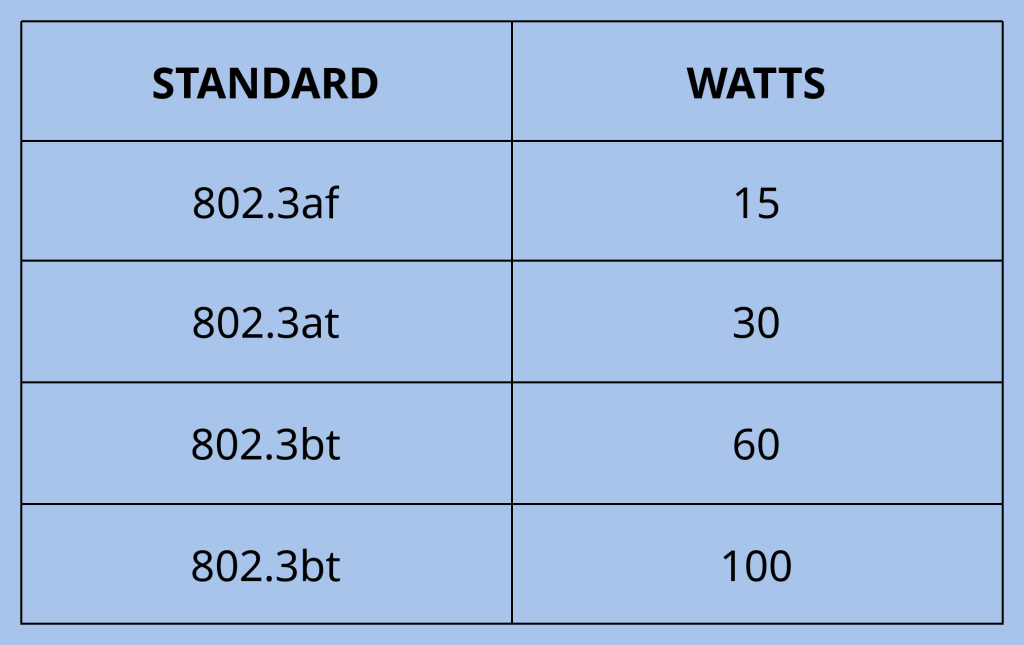
POE is defined by IEEE and comes with different standards such as 802.3af, 802.3at, and 802.3bt. Each standard provides a different level of power.
VoIP- A device that is known for using POE is an IP phone that uses VoIP which stands for Voice over IP. VOIP allows voice communication to be transmitted over IP networks instead of traditional telephone lines. In VOIP, analog voice signals are converted into digital data packets, encapsulated and delivered to their intended destination over an IP network. When the packet arrives at its destination, it’s then decapsulated and converted back into a voice signal.
Leave a Reply