Today I will be discussing topology types including full mesh, partial mesh and star.
Every topology type has their own unique strengths and weaknesses when it comes to implementation.
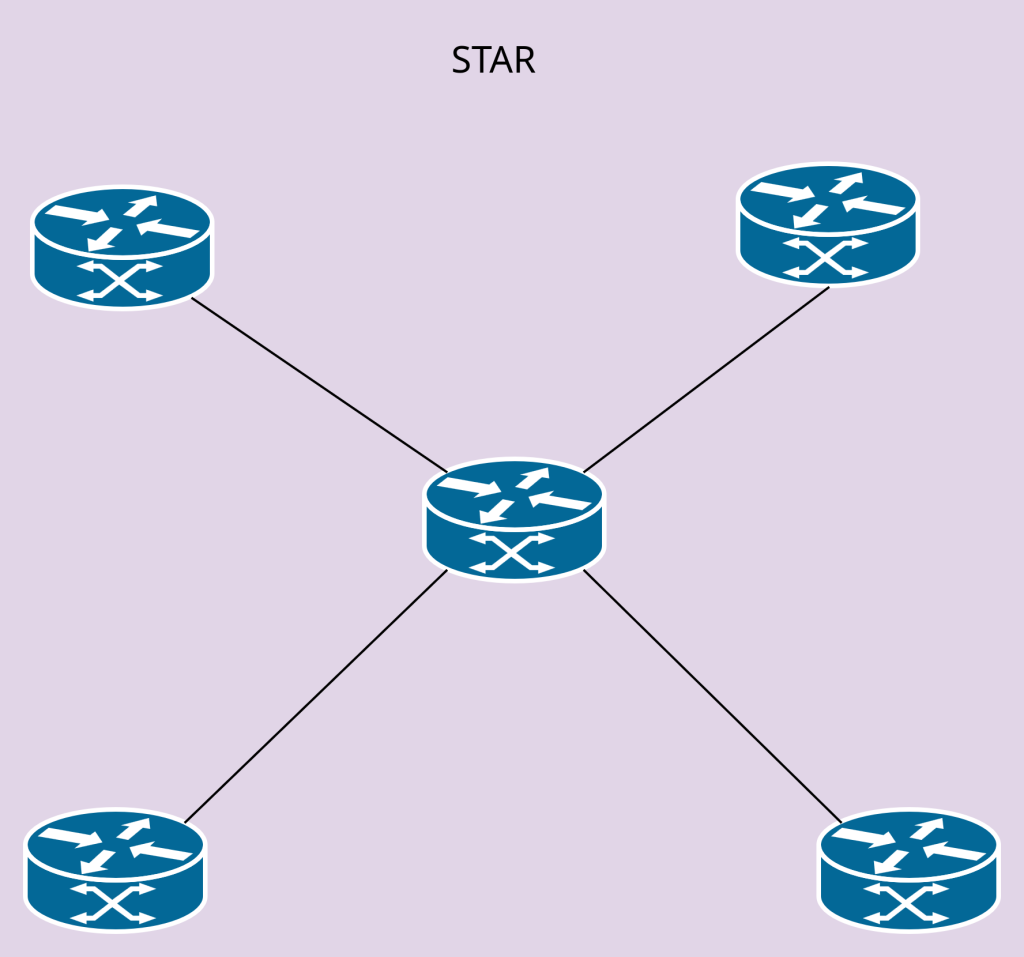
Star- The first topology type I will be discussing is a “star” topology. A star topology is a network design in which each device in the topology has a direct connection (point-to-point link) to a central device. The central device is typically a switch and usually acts as the main communication point that receives traffic from connected devices and forwards it to the appropriate destination device. The central device is vital to the topology because without the central device, end devices cannot communicate with another end device without passing through the central device. End devices in a star topology are not allowed to have direct connections with each other.
Star Pros:
- A star topology is easily scalable, meaning adding a device only takes one cable and the device interconnects to it. No major network redesign needs to be done.
- A star topology has fault isolation, because each device has its own dedicated connection to the central device, a failure in one cable or network device only affects that device, while the rest of the network remains operational.
Star Cons:
- The bad part of a star topology is that there is a single point of failure. If for any reason the central device shuts down or is malfunctioning, the entire network will not be able to communicate.
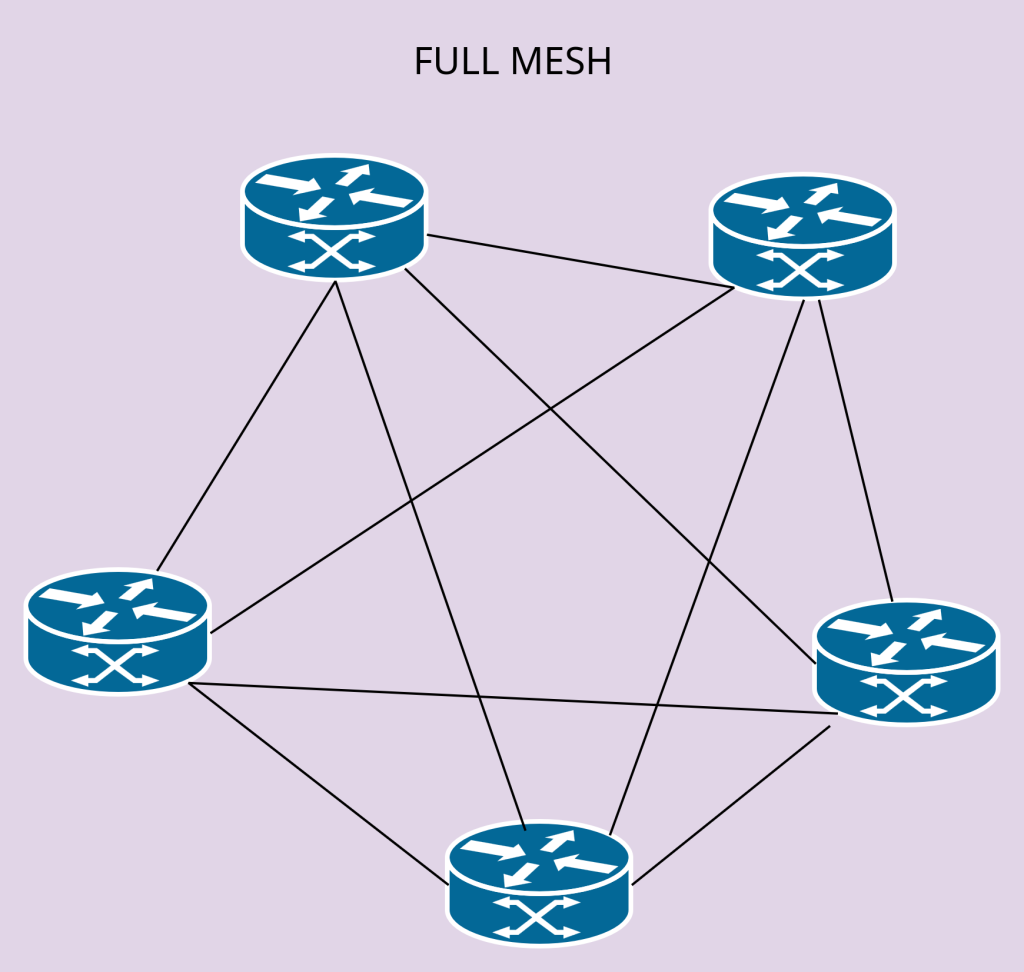
Full Mesh- The next topology is a “full mesh” topology. A full mesh topology is a network design in which each device has a direct connection to every other device in the network.
Full Mesh Pros:
- Since every device is connected to every other device, this creates multiple alternate paths that provide high reliability and fault tolerance because traffic can still flow through other direct connections if a link fails.
Full Mesh Cons:
- Although there are plenty of redundant active links that provide alternate paths, this creates more complexity when scaling and the cost will be higher. For example a network with 50 full mesh devices, adding one device will need 49 cables just for one device to be added.
- Full mesh calculation:
n(n-1)/2
Full Mesh Example:
5 devices = 10 links50 devices = 1,225 links
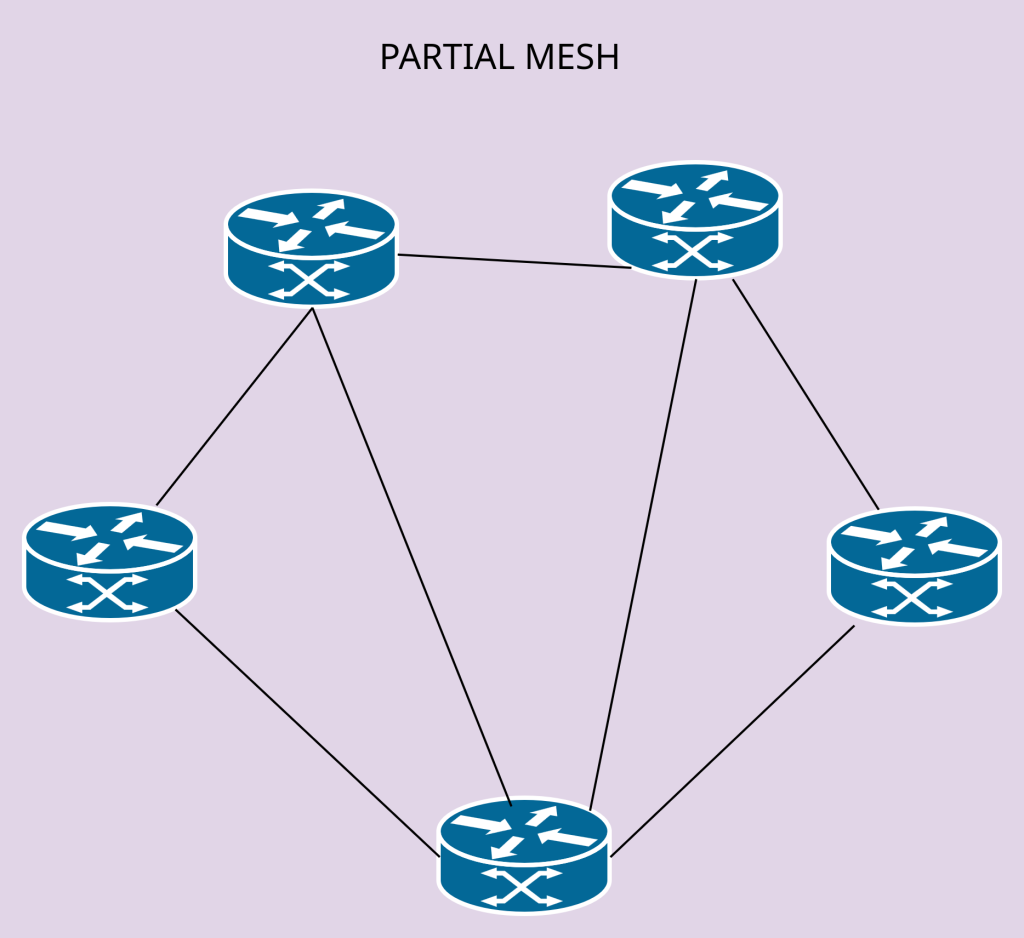
Partial Mesh- The next topology is a “partial mesh topology”.” A partial mesh topology is a network design in which only selected devices are directly interconnected.
Partial Mesh Pros:
- Since only selected devices are chosen, this provides redundancy and alternate paths only where needed without requiring each device to connect to every other device.
Partial Mesh Cons:
- The bad part about a partial mesh topology is that based on the design, some traffic may experience higher latency or reduced redundancy compared to its counterpart “full mesh.”
Leave a Reply