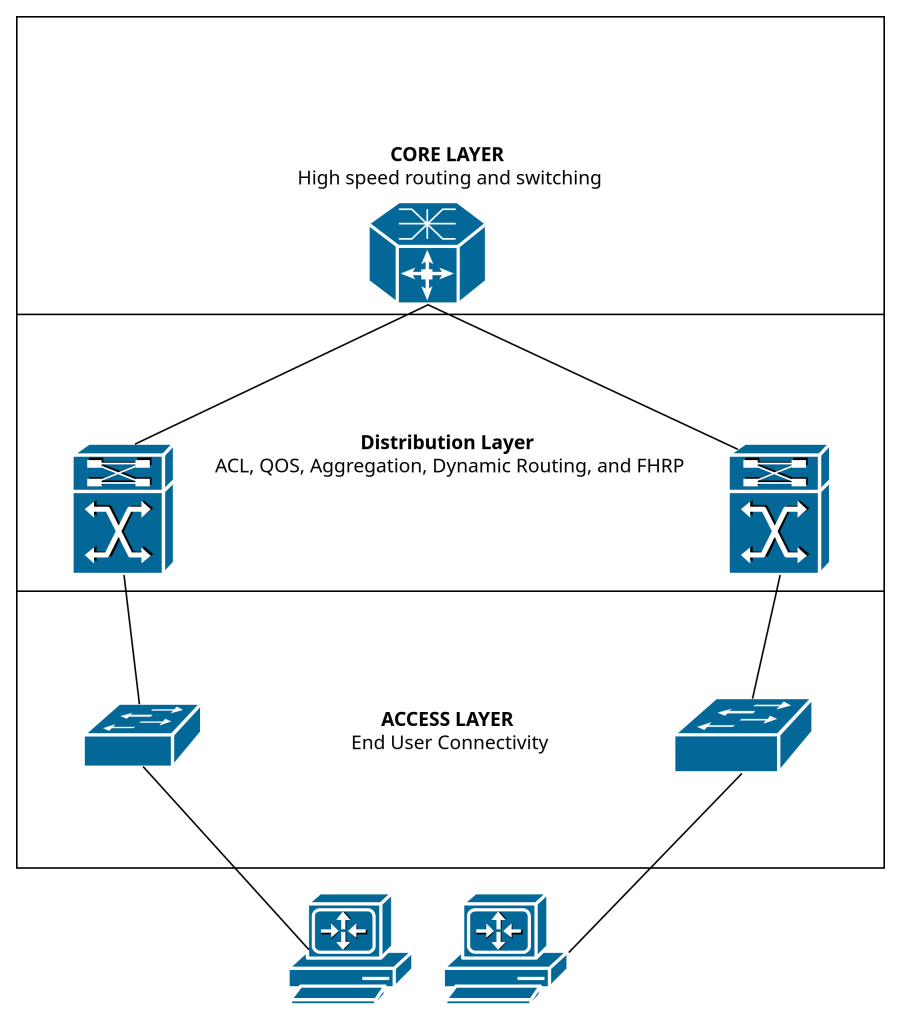
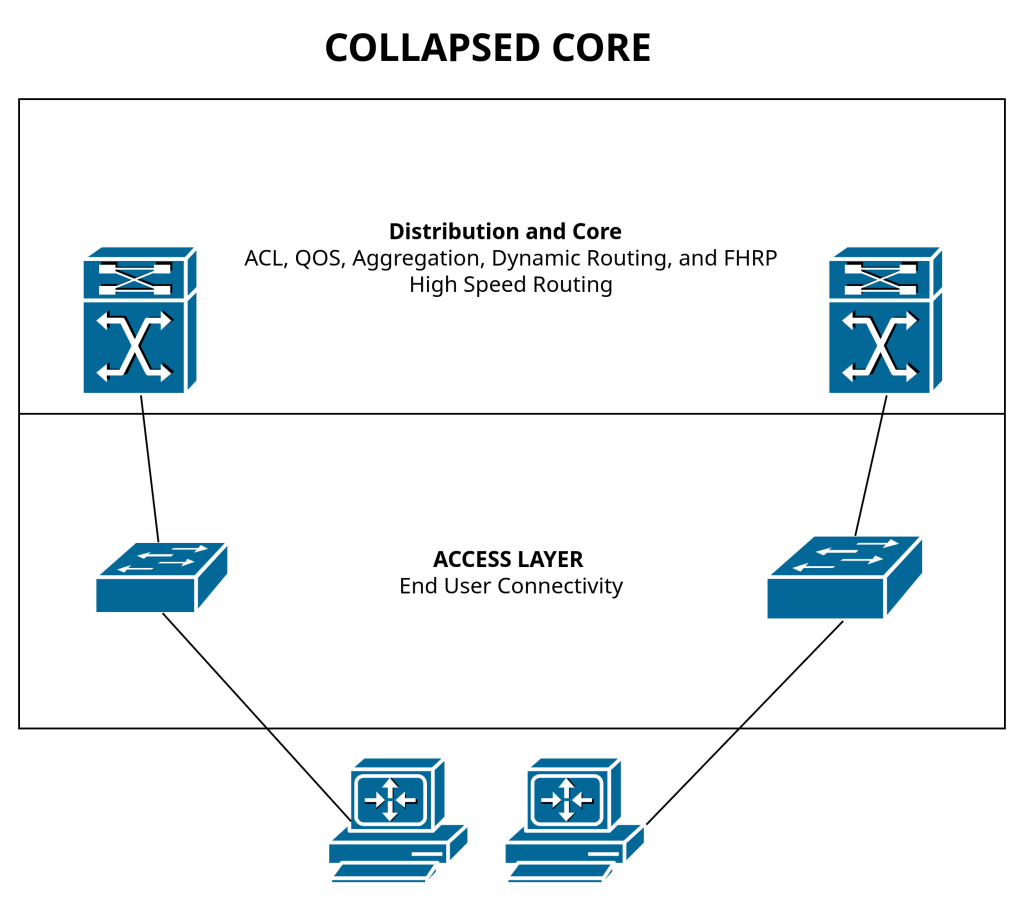
Today I will be discussing the “Three Tier Model” and the “Collapsed Core Model.” The three tier design consists of three tiers while the collapsed core is two layers. The collapsed core is used when the costs do not justify having a complex three tier setup and to minimize unnecessary complexity. The functions (layers) that will be found in both of these are the access, distribution, and core layers, the only difference is how they are implemented.
Access Layer- The first layer in the three tier model is the “access layer.” This layer is responsible for providing connectivity for end user devices. The access layer acts as the edge or entry point where end user devices such as PCs, printers, laptops, or phones physically enter the network. Aside from providing connectivity, this layer is responsible for first-hop security and network access policies including VLAN assignment, port security, 802.1X authentication and protection against rogue devices using features such as DHCP snooping and DAI (Dynamic ARP Inspection.) This layer also responsible for part of the QOS process. Its responsibility in QOS is classification and marking, where it identifies traffic types such as video and voice, and marks them so upstream devices can prioritize the traffic appropriately.
Distribution Layer- The next layer in the three tier model is the “distribution layer.” This layer is also sometimes called the “aggregation layer,” because its main role is to aggregate or collect traffic from multiple access layer switches and forward it toward the core layer. Aside from traffic aggregation, this layer is responsible for performing inter-VLAN routing, enforcing policies such ACL filtering and QOS, and providing services such as default gateway redundancy (HSRP, VRRP, GLBP.) The distribution layer also participates in dynamic routing protocols and route summarization between the acces and core layers. This layer essentially acts as the intermediary of the access layer and core layer. This layer is also acts as a layer 3 boundary, meaning that issues that occur at the access layer such as VLAN misassignments, rogue devices, layer 2 broadcasts, broadcast storms, or MAC flooding are isolated and filtered by the distribution layer so that they do not propagate to the core layer of the network.
Core Layer- The final layer of the three tier model is the “core layer”.” This layer is dedicated solely as the network backbone where its job is to provide fast, reliable, and highly available transport of traffic between distribution layer blocks or other major sections of the network infrastructure. This layer is designed to be as simple as “forward traffic as fast as possible, and that’s it.” The core layer avoids any CPU intensive operations such as ACL filtering, inter-VLAN routing policies, or complex QOS classifications. Instead it performs hardware based routing and switching using ASIC (Application Specific Integrated Circuits) to move traffic at wire speed. Wire speed means that the device is forwarding traffic at the physical links fullest/maximum possible capacity, and ASICs are specialized hardware chips built into network devices to perform tasks like packet forwarding, routing and switching at wire speed with low latency.
Collapsed Core- Now that we know what the 3 layers do, I can now discuss the “Collapsed Core” model. This is a two tier hierarchical network design that combines the distribution and core layer into one layer. In this model, the access layers still exist and still perform the same duties with the main role being to provide connectivity to end user devices. The collapsed core layer handles both aggregation, enforcing network policies (QOS and ACL), and high speed routing functions of the distribution and core layers.
Leave a Reply