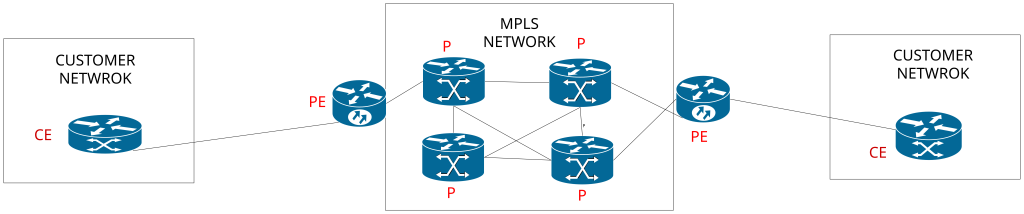
Today I am going to be discussing MPLS which stands for Multi Protocol Label Switching. This is a WAN technology used by service providers such as ISPs to forward traffic across large networks efficiently using “labels,” instead of using the traditional method of doing a routing table lookup. These labels are basically instructions to tell the router where to forward the packet. These labels are confined to the inside of the service providers network only. Since MPLS uses labels, this makes MPLS protocol agnostic. This means that the format being sent to the MPLS network can be in any format such as IPv4, IPv6, Ethernet, Voice or VPN and they will all traverse the same infrastructure without any problem.
MPLS has multiple roles for each router in the network. A router can either be a CE router (Customer Edge Router), PE router (Provider Edge Router), or a P router (Provider Router.) Each of these routers serve a unique role in order for traffic to move effectively in and out of the MPLS infrastructure.
CE- A CE router is a customer owned router that is located at the boundary of the customers network and the providers MPLS network. This router connects directly to the PE router, communicates, and routers packets to the PE router using standard routing protocols such as OSPF, BGP, EIGRP, or static routing. This router functions basically like a normal router, but its primary role within the MPLS structure is to send and receive customer traffic to and from the provider MPLS network. The CE router is completely MPLS-unaware, meaning that it only processes standard IP packets and does not see any kind of MPLS labels that are used within the provider’s MPLS network.
PE- The next router is the PE router. The PE router is the service provider router that is located at the edge of the MPLS network. The PE router acts as the entry and exit point where customer traffic enters and leaves the MPLS infrastructure. This router’s role can be seen as a hybrid because it has duties that have to do with traditional routing and duties that have to do with MPLS label switching. The PE router is the router in the MPLS infrastructure that performs the most advanced functions such as:
- Learning customer routes
- Assigning MPLS labels to incoming traffic
- Maintaining different VPN routing information for different customers
- Performing route separate via VRFs (Virtual Routing Forwarding)
- Forwarding labeled packets into the provider core
- Adding and removing MPLS labels when packets enter and leave the MPLS infrastructure
The final router in the MPLS network is the P router. The P router is a high speed transit node located inside of the service provider MPLS core backbone. Its primary duty is to perform label switching.
Label Switching- Label switching is the process used by MPLS. The process for label switching starts with a packet being assigned a label. The packet will then traverse the MPLS network while routers forward the packet based on the label using a label forwarding table instead of a full IP routing table lookup. At each hop, the router will typically swap the existing label, and apply a new label for the next hop. The packet will be forwarded to the next router, and this process will continue until the router reaches the destination edge router which will be the PE router. The router will remove the label and the original packet will be forwarded to its final destination.
P Router- The P router is designed for high speed, low latency forwarding and has a simplified role of forwarding the labeled packet as efficiently as possible. Unlike the PE router, the P router is completely unaware of the customer. It is isolated inside the MPLS infrastructure so it never communicates with the CE router and does not maintain any customer-specific routing information, and focuses solely on performing label switching.
Layer 2 MPLS- Another feature of MPLS is that it offers a “layer 2 MPLS VPN.” This is a unique feature that allows CE routers to communicate as if they were directly connected, making the MPLS network transparent. In a layer 2 MPLS VPN, the MPLS infrastructure is completely invisible to the customer. Since the MPLS infrastructure is invisible to the customer, when CE routers communicate via MPLS layer 2 VPN, the CE routers behave as though they are directly connected on the same layer 2 network. This connectivity allows the CE routers to bypass forming routing protocol adjacencies with the PE router, instead forming routing protocol adjacencies (such as OSPF) between CE routers instead.
Leave a Reply