Today I am going to be discussing the different types of WLC interfaces which are:
- Management Interface
- Service Port Interface
- Virtual Interface
- Dynamic Interface
- Management Redundancy Interface
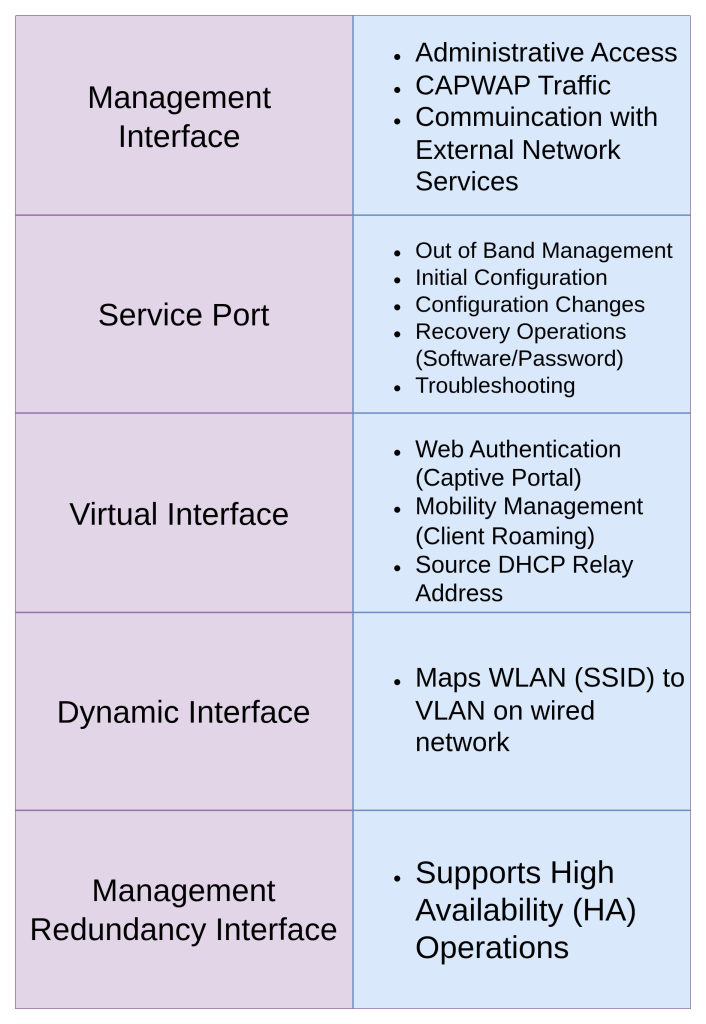
Management Interface – The management interface is the primary logical (not tied to a physical port) interface used for controller management and supporting its day to day wireless operations. There are three main roles that a management interface is used for:
- The management interface is assigned the IP address that allows administrative access to the WLC through management protocols such as HTTPS, SSH and SNMP.
- The management interface is also the interface through which lightweight APs communicate with the controller using the CAPWAP protocol.
- The management interface is also the interface that handles communication with external network services such as RADIUS authentication server, DNS, NTP, and syslog servers.
Unlike a service port, which is reserved for out-of-band maintenance or recovery, the management interface participates in the production network and is essential for day to day controller activities. The management interface serves as the central communication point through which the WLC exchanges CAPWAP traffic with APs, communicates with external network services (DNS, RADIUS), and provides administrative access to the controller via IP address.
Service Port – A service port is a dedicated out-of-band management interface used primarily for initial setup, maintenance, troubleshooting and controller recovery. Unlike the management interface, the service port does not participate in the normal wireless operations like forwarding CAPWAP traffic and is isolated from the production network. Instead of being an interface that forwards traffic, it instead provides direct access to the WLC using a separate ethernet connection.
The type of tasks performed at a service port is:
- Initial configuration
- Software Recovery
- Password recovery
- Low level diagnostics
The main perk of a service port is that it functions apart from the actual production network interfaces, meaning that if the production interfaces are down or misconfigured, the service port will be accessible and won’t be affected by that. This creates an isolation that benefits the administrative staff because they will be able to troubleshoot, make configuration changes, and perform recovery operations even during network outages or failures, making it a great interface for emergencies.
Virtual Interface – A virtual interface is a logical interface that is not connected to any physical port or VLAN. This interface is used to support specific wireless services rather than carrying normal network traffic. A virtual interface supports controller services such as:
- Web Authentication: A virtual interface supports web authentication which is aslo known as a captive portal, by providing a consistent redirect address for wireless clients.
- Mobility Management: A virtual interface supports mobility management between controllers during client roaming by providing a stable internal address.
- DHCP Relay: A virtual interface supports certain DHCP operations by providing a consistent source relay agent address (GIADDR) for client DHCP requests being sent to an external server.
Because the virtual interface is an internal logical (not attached to any physical port) interface, it does not participate in normal routing and does not carry management traffic, CAPWAP traffic, or wireless client data traffic. Instead, it provides a stable internal address used by the WLC for web authentication, mobility management, DHCP related operations, and other controller services.
Dynamic Interface – A dynamic interface is a logical (not associated with any physical port) interface used to map wireless client data traffic from a specified WLAN (SSID) to a matching VLAN on the wired network. Although the communication is wireless the backbone of a wireless network is typically a wired network. This means that wireless clients can also be attached to VLANs, meaning that every SSID is connected either to a custom configured VLAN or the default VLAN, depending on the default configuration.
Each dynamic interface will be configured with a VLAN ID, IP address, subnet mask, and default gateway, allowing the WLC to forward the wireless traffic to the correct wired subnet. When a client connects to an SSID, the WLC forwards the client’s traffic through the dynamic interface associated with that WLAN (SSID), placing the client into the corresponding VLAN on the wired network. This allows network segmentation for wireless users as well, allowing organizations to separate employee, guest, IP phone and IOT device traffic for security, policy enforcement (ACL), or traffic management (QOS.)
Management Redundancy Interface – The management redundancy interface is a logical interface used to support high availability (HA) operations between two controllers that are configured as an active and standby pair. The main purpose of the management interface is to provide management communication and synchronization between the active and standby WLCs, so that the standby controller maintains an active and current (up to date) copy of the active controller configuration and operational state. Allowing the standby controller to have a current and active configuration and operational state of the active controller ensures that it can provide a fast convergence turnover if the active WLC were to fail. This allows the wireless network to experience minimal downtime and disruption to wireless services. Unlike the management interface, the redundancy management interface is dedicated primarily for high availability (HA) operations, meaning it does not carry any wireless client data traffic or CAPWAP traffic.
Leave a Reply