Today I am going to talk about GLBP (Gateway Load Balancing Protocol), which is another FHRP but this time with major differences on how it functions. GLBP is another Cisco proprietary protocol that provides gateway redundancy but also provides load balancing on top of it. Instead of having the typical FHRP master/active router with a backup/standby ready to take over, it has multiple routers forwarding traffic at the same time.
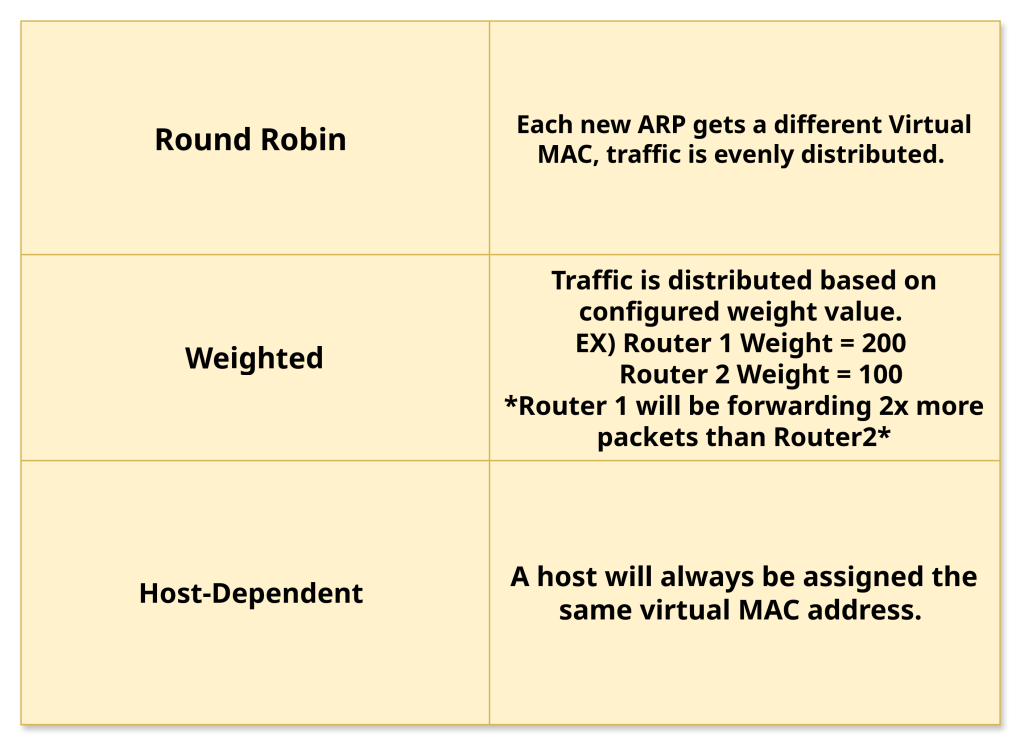
AVG- GLBP allows multiple routers to forward traffic at the same time by dividing routers into two roles which are AVG (Active Virtual Gateway) and AVF (Active Virtual Forwarders). The main router responsible for managing the GLBP group is called the AVG. The AVG is elected from the GLBP by selecting the router with the highest priority and if there is a tie then the highest IP address. The AVG plays an important role in the GLBP group as it is responsible for assigning virtual MAC addresses, responding for ARP requests for the virtual IP address, orchestrating the load balancing, and monitoring the health of all the AVFs. Just like all of the protocols in FHRP, the AVG and the AVF will share the same virtual IP for the GLBP group but the difference in this protocol is that the AVFs will all be assigned different virtual MAC addresses so traffic can flow through all of them simultaneously. AVG does the onboarding for assigning MAC addresses, then takes the responsibility for answering every ARP request. Once the AVG receives an ARP request, it will then send an ARP reply with the AVF that will be assigned to that host. The choice of the AVF assigned to that host will be determined by the load-balancing protocol chosen. The load-balancing options for GLBP are host-dependent, round-robin, or weighted.
AVF- The AVFs in the GLBP group are all the routers that are actually doing the forwarding of packets. They all share the same virtual IP but have unique virtual MAC addresses from one another. Just like VRRP and HSRP, there is a specific format for how you will see GLBP virtual MACs. If you see a virtual MAC look like this 0007.b4XX.XXYY then it is most likely a GLBP virtual MAC address. The AVG answers the ARP request and chooses one of the AVFs, and the AVF just forwards the traffic simultaneously while other AVFs are forwarding traffic for other hosts as well. The max number of AVFs that can be forwarding traffic at one is 4 per GLBP group. This set up not only provides redundancy and load-balancing but also failover. If one of the AVFs were to fail, then one of the other active AVFs in the group will be assigned that failed AVFs virtual MAC by the AVG. This means that the AVF being assigned the failed AVFs virtual MAC will be forwarding traffic for two MAC addresses temporarily. This is an intentional design by GLBP so that traffic will not be interrupted in case of a failure of any kind providing a high availability solution for companies who choose so. The AVG also has the ability to function as an AVF also meaning that not only can it take the responsibilities of the AVG (assigning MACs, answering ARP requests) but it can also forward traffic and be one of the 4 actively doing so.
Hello Packets- Hello packets are also sent in GLBP, and they are used to select the AVG/AVF roles and to monitor the health of AVFs and the AVG in the group. The timer is similar to HSRP with a hello timer of 3 seconds and a hold timer of 10 seconds. Hello packets are sent by both the AVG and the AVFs. The hello packets are sent to the multicast address of 224.0.0.102 the same HSRP version 2 hello packet multicast address. If any of the AVFs were to not send a hello packet within the hold timer of 10 seconds, then the AVF will be declared dead (inactive) and another AVF will be assigned their virtual MAC.
HSRP: https://networkingnotebook.com/?p=702
VRRP: https://networkingnotebook.com/?p=699
Leave a Reply