Today I am going to talk about IPv6 which is another Internet Protocol that was created to address the exhaustion of IPv4 addresses. IPv6 was created in hopes of going from IPv4 to the internet being completely IPv6, but never fully took over because of mechanisms such as NAT and RFC 1918 private addressing that can overlap with multiple LANs.
Even though IPv6 is another internet protocol, just a different version there are a lot of differences in how it works. First off it uses hexadecimals instead of decimals. Decimals range from 0 – 9, while hexadecimal ranges from 0 – 9 and A – F. IPv6 is much more longer with a total bits of 128. Its format has 8 groups and each group includes 16 bits.
The set up is different as well, IPv4 is set up as a network portion followed by the host portion. A subnet mask is also usually attached to an IP so the network portion is identified. With IPv6, there are three groups called the global routing prefix, subnet ID and the interface ID. As you can see there is no separate dotted-decimal subnet mask address with IPv6 but has a dedicated portion of the address for it. Instead the prefix length decides the network portion.
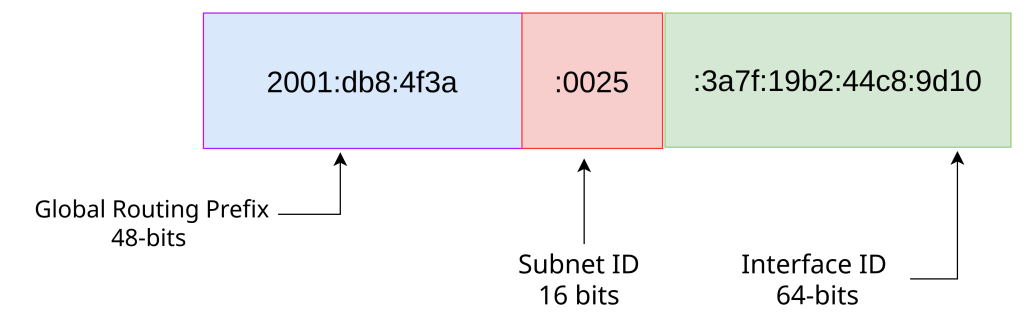
Global Routing Prefix- In IPv6 the global routing prefix is the portion of an IPv6 address that is used to identify a specific network or organization on the internet for routing purposes. These are the most significant bits of the address and are completely unique for GUA (Global Unicast Addresses.) These global routing prefixes are assigned by Internet registries such as RIR (Regional Internet Registries) to ISPs which then assign them to organizations or customers. This is the identifier on the internet. Global routing prefix is commonly 48 bits which will equate to the first 3 16-bit groups (although it can be /56 or /64 depending on ISP). If CVS has a global routing prefix like 2001:db8:4f3a, any packet starting with that address will be routed to one of the networks owned by CVS.
Subnet ID- The next portion of the IPv6 address is the subnet ID. This is a 16 bit portion (if the global routing is /48) of the IPv6 address taking up 1 group out of 8. This is used to enable hierarchical IP address designs within a company. The subnet ID helps identify specific subnets within a larger network. A subnet is a logical portion of a larger network. It is basically taking a larger IP block that is one IP network and breaking it apart into multiple smaller networks. So if 1 IP network is divided into 10 subnets, that single network will now have 10 smaller layer 3 networks. Devices in one subnet cannot communicate with devices in other subnets without routing. Back to the CVS example if they decide to have multiple subnets, 2001:db8:4f3a:0001 would identify one subnet and 2001:db8:4f3a:0002 would identify a completely different subnet. Devices would not be able to talk to each other without layer 3 routing, subnets are great for management, and organization such as having a marketing subnet, finance subnet, and sales subnet.
Interface ID- The last but not least portion of an IPv6 address is the interface ID. This is the last 64 bits of the address and takes up 4 out of the 8 groups. This is used to identify any interface on a device. If a device has multiple interfaces that are configured with IPv6 enabled, each interface will have a different interface ID. This resembles the host portion in IPv4. Interface ID in IPv6 can be assigned automatically via SLAAC (EUI-64 or randomly generated interface ID), manually, or DHCPv6
Leave a Reply