Today I am going to talk about multicast scopes. Multicast is a message type that is used to transmit a single stream of data to a group of interested recipients who have displayed interest in receiving that data by joining a “multicast group.” The original data stream is only transmitted once, and network devices such as routers retransmit those packets to the destination. Multicast is widely used for IPTV, video conferencing usually for corporations, financial market data, and used by a lot of routing protocols (OSPF, RIPv2, EIGRP.) Multicast can be transmitted within different types of scopes, scope meaning how far the multicast packet will travel.
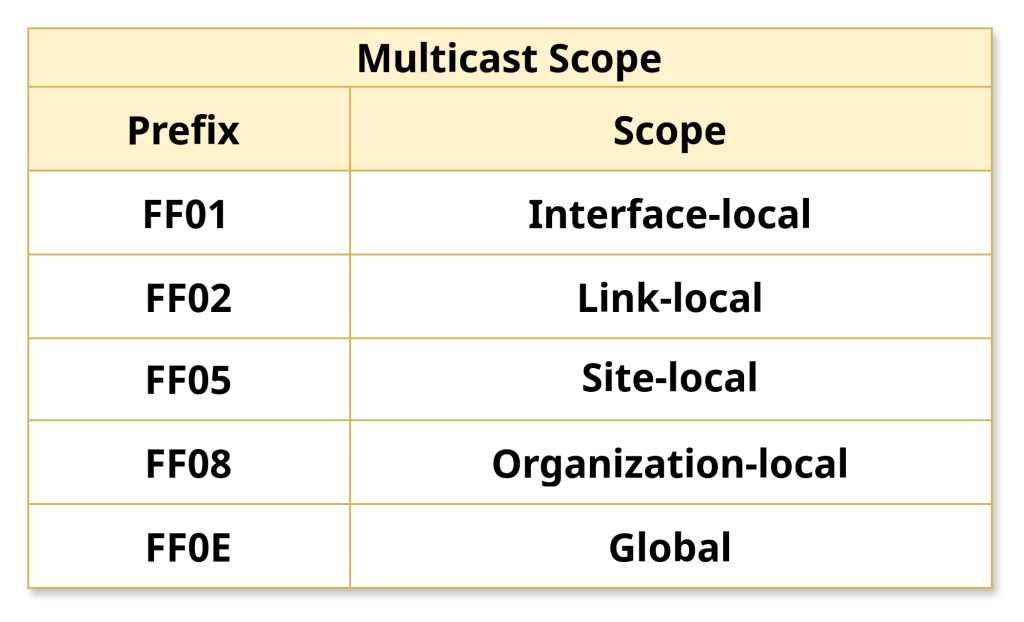
Interface-local- The first scope starts with the prefix FF01 and it is an interface-local scope. An interface-local scope is confined within one physical port, and is not able to travel beyond it. When a multicast for interface-local is sent, no one except the sending device will receive it, only other processes on the same device.
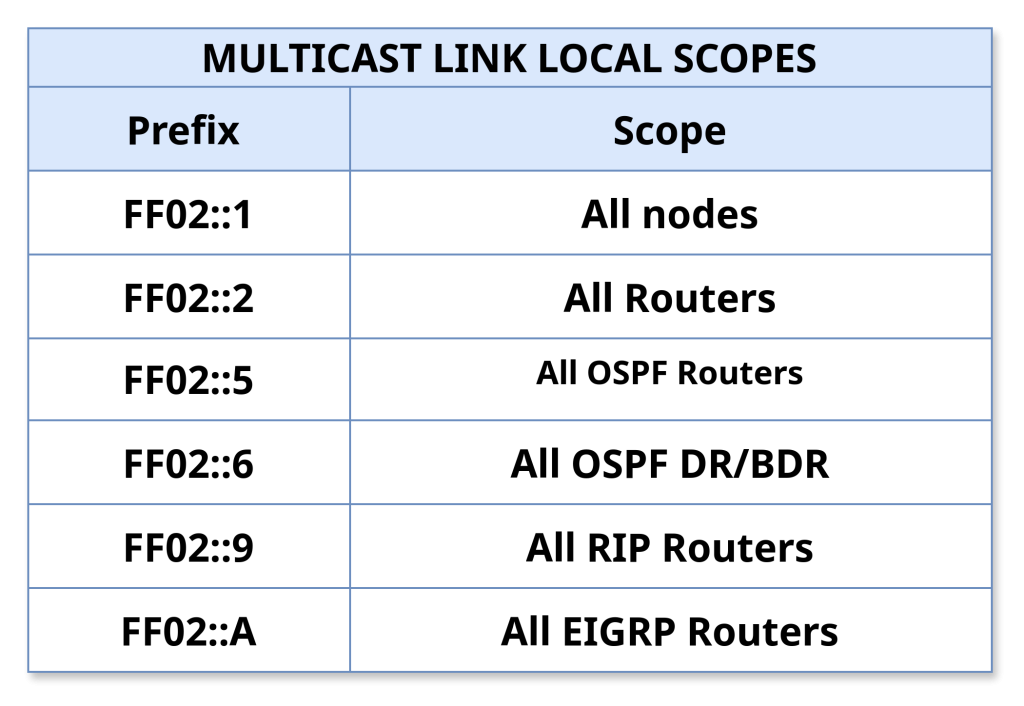
Link-local- The second scope starts with the prefix FF02 and it is a link-local scope. This is a commonly used scope for dynamic routing protocols, as they use this to discover neighbors and send routing updates. OSPF for example uses FF02:5 (All OSPF routers) for hello messages to discover neighbors, and when the topology is fully converged DR Others send routing updates only to DR and BDR routers via FF02::6(DR and BDR routers only). This scope is limited only to the local link (segment) only, meaning these packets will never get past the default gateway. Link-local scopes are also popular within NDP for RS (Router Solicitation) and RA (Router Advertisement) messages using FF02::1 for all nodes and FF02::2 for all routers.
Site-local- The third scope starts with the prefix FF05 and it is a site-local scope. This scope is limited to one geographical area such as a building, campus, office, and any other environment. These multicast packets can cross routers but will not go past the border routers on the current site nor traverse the public internet.
Organization-local- The fourth scope is wider with the prefix of FF08 and is an organization-local scope. Multicast packets in this scope can cross routers and even be forwarded to hosts in a different location as long as it is within the organization or private network. It is not allowed to be routed to different autonomous system networks or the public internet, but it can move anywhere within an autonomous system including other subnets.
Global- The final multicast scope is the widest one with the prefix of FF0E called the global scope. This multicast packet can be routed across the IPv6 Internet. As long as the route is reachable it is possible. This scope is common for public services such as financial market data or IPTV where anyone is allowed to join.
Leave a Reply